If you haven't been harassed by NCO Financial, it's just a matter of time. This Pennsylvania company claims to be a legitimate collection agency, but they have been sued by several state attorneys general, have a huge file of complaints at every BBB in the country, and violate every rule of conduct required of collection agencies by law. Google them. Or Goggle 18666278195. Both their name and number usually show up in your caller ID.
They started harassing me about two months ago. I get at least one call a day, usually more. They use predictive dialling, so it's easy to spot them, even if you don't have caller ID. My habit is simply to hang up if a real person is not immediately on the line. Sometimes they have a recording that gives you a clue.
Today I finally got the only clue I need; the recording said they wanted to speak to David Somebody. I forget the name, but it wasn't mine.
I've had this phone number for about ten years, far longer than the statute of limitations for most kinds of debt in this state. So even if they have the "right" phone number for the debtor, they are basically beating a dead horse. That explains the horror stories you can read on the Internet about people who have been silly enough to stay on the line and try to reason with them. The NCO Financial people actually start screaming and using foul language if you dare tell them they have the wrong number.
They can do a reverse look up of the phone numbers they call and find the name of the person who owns that number. If that doesn't convince them that they have the wrong number, I'm certainly not able to do it by staying on the line and hearing their tirade.
NCO Financial is not the only bunch of crooks trying to collect noncollectable debts from the wrong people. Googling sleazy or crooked collection agencies will turn up many more.
Bottom line is that any legitimate debt collection agency will have the Social Security number of the debtor; they can easily find the current address of the right person. If they can't send you a certified letter, they are not legitimate.
Since these slimebags don't even know my name, I feel fairly safe from damage to my credit report, but I'll keep an eye out. The last thing I want to do is tell them my real name; with my luck they would claim I'm using an alias and then I would really feel their assault. Meanwhile, let them waste their time calling the wrong number. Caller ID and Google are my friends.
Now if only Vonage would offer a call-blocking feature! You would think that some bright engineer would offer a device that handles this for you, but the only one I have ever found is Caller ID Blocker and it appears to be permanently out of stock.
+++++++++++++++++++++++++++++++++++
2/20/09 Good news! I found a used Caller ID Blocker for 1/2 price and also found some PC software (callclerk) that does the same job and more. Also, the mystery of what became of the Caller ID Blocker company is solved. They (InterceptorID) are working on a new version and ran into quite a few unexpected snags - like their manufacturing vendor lost the tools used to make the original and they are now being recreated by InterceptorID.
Thursday, February 19, 2009


Wednesday, February 11, 2009
Blessed BeThe Newsmakers
Steven Bates has a priceless article in Slate today titled Blessed Be The Newsmakers. His thesis is that newspapers can stop their decline by declaring themselves as a religion.
"... as New York University's Jay Rosen points out (and noted earlier), American journalism itself constitutes a sort of religion, "a belief system and meaning-making kit that is shared across editorial cultures in mainstream newsrooms." What qualifies as news reflects an idealized notion of democracy. Public corruption brings forth righteous wrath from the press's pulpit. Reporters strive to "evoke indignation at the violation of social values," media scholars James S. Ettema and Theodore L. Glasser observe in their book "Custodians of Conscience"—as, they add, the prophet Jeremiah did."
"Just as the Puritans vowed to purify the Church of England, journalists seek to purify the country's institutions of self-government. "Democracy," Philadelphia Evening Bulletin editor Fred Fuller Shedd declared in 1931, 'functions largely through the efficient service of the newspaper'—no great leap from 'No one comes to the Father except through me.' The Scripps Newspapers' motto admonishes, 'Give Light and the People Will Find Their Own Way.' See also John 8:12: 'I am the light of the world.'"
Bates concludes with "It shouldn't be that hard to reposition the press as a church. It's already halfway there." Well, maybe that's an average, but the New York Times has been there for decades.
"... as New York University's Jay Rosen points out (and noted earlier), American journalism itself constitutes a sort of religion, "a belief system and meaning-making kit that is shared across editorial cultures in mainstream newsrooms." What qualifies as news reflects an idealized notion of democracy. Public corruption brings forth righteous wrath from the press's pulpit. Reporters strive to "evoke indignation at the violation of social values," media scholars James S. Ettema and Theodore L. Glasser observe in their book "Custodians of Conscience"—as, they add, the prophet Jeremiah did."
"Just as the Puritans vowed to purify the Church of England, journalists seek to purify the country's institutions of self-government. "Democracy," Philadelphia Evening Bulletin editor Fred Fuller Shedd declared in 1931, 'functions largely through the efficient service of the newspaper'—no great leap from 'No one comes to the Father except through me.' The Scripps Newspapers' motto admonishes, 'Give Light and the People Will Find Their Own Way.' See also John 8:12: 'I am the light of the world.'"
Bates concludes with "It shouldn't be that hard to reposition the press as a church. It's already halfway there." Well, maybe that's an average, but the New York Times has been there for decades.
Tuesday, January 27, 2009
Long Droughts & Rising Seas
The message from "top international scients" remains confused. This from the Washington Post today:
Tuesday, January 27, 2009; Page A04
"Top climate researchers from the U.S. National Oceanic and Atmospheric Administration, Switzerland and France said their analysis shows that carbon dioxide will remain near peak levels in the atmosphere far longer than other greenhouse gases, which dissipate relatively quickly.
...
"The new study, published in the Proceedings of the National Academy of Sciences, projects that if carbon dioxide concentrations peak at 600 ppm, several regions of the world -- including southwestern North America, the Mediterranean and southern Africa -- will face major droughts as bad or worse than the Dust Bowl of the 1930s. Global sea levels will rise by about three feet by the year 3000, a projection that does not factor in melting glaciers and polar ice sheets that would probably result in significant additional sea level rises."
Huh?
Let's review a little history. The Kyoto conference was a failure for two reasons. 1. The US has not ratified their 7% reduction committment. China, India and Russia made no commitment to reductions. 2. It was widely admitted that even if all countries made a committment of reducing emmissions by 8%, it would not significantly reduce the CO2 content of the atmosphere. Presumably nothing short of eliminating the human race would help. So what has happened since 1998?
Very few countries made progress by 2005 toward their 2012 CO2 reduction goal. The few that have reduced emissions did so for reasons unrelated to Kyoto, for example the economic collapse of the USSR. The price of oil and other economic conditions have far more to do with CO2 emissions than political rhetoric.
And what about sea level? 30 foot rises! in 1000 years. 92 cm per century for ten centuries. Somebody is fudging the numbers again. In the 20th century, in geologically stable areas, sea level rose 20 cm at a constant rate, the prime contributor being thermal expansion. Previous estimates of the maximum possible rise had been 80 centimeters including the maximum rate at which glaciers could travel to the sea. Every "expert" has a different number. None of them seem to explain where they got it. Let's be grateful they didn't plot this new "hockey stick" on graph paper.
The predictions simply don't hold up when compared to historical records. If CO2 content is the critical factor in the temperature of the atmosphere, why have temperature and sea level risen so steadily in the past 8000 years? Why is there absolutely no correlation between CO2 content and temperature over geologic history?
As for the dust bowl threat, don't these people even read human history? 5000 years ago southern Iraq was a vast forest. The human race was not destroyed as a result of the desertification of Babylonia, no matter what caused it.
So now the big news is that nothing we can do will change anything and [therefore] we must act now! Somehow, the message is getting garbled. Apparently we can all agree that nothing we pitiful humans can do is likely to affect global temperature. So how much money will it cost to try? And how much money would it cost to move up hill 30 feet in the next 1000 years?
By the way, is anyone asking what the benefits may be of "global warming?" If they aren't asking, why not? If there are no benefits, then show that to be the case. This "thing" looks less like science than politics.
Tuesday, January 27, 2009; Page A04
"Greenhouse gas levels currently expected by mid-century will produce devastating long-term droughts and a sea-level rise that will persist for 1,000 years regardless of how well the world curbs future emissions of carbon dioxide, an international team of scientists reported yesterday.
"Top climate researchers from the U.S. National Oceanic and Atmospheric Administration, Switzerland and France said their analysis shows that carbon dioxide will remain near peak levels in the atmosphere far longer than other greenhouse gases, which dissipate relatively quickly.
...
"The new study, published in the Proceedings of the National Academy of Sciences, projects that if carbon dioxide concentrations peak at 600 ppm, several regions of the world -- including southwestern North America, the Mediterranean and southern Africa -- will face major droughts as bad or worse than the Dust Bowl of the 1930s. Global sea levels will rise by about three feet by the year 3000, a projection that does not factor in melting glaciers and polar ice sheets that would probably result in significant additional sea level rises."
Huh?
Let's review a little history. The Kyoto conference was a failure for two reasons. 1. The US has not ratified their 7% reduction committment. China, India and Russia made no commitment to reductions. 2. It was widely admitted that even if all countries made a committment of reducing emmissions by 8%, it would not significantly reduce the CO2 content of the atmosphere. Presumably nothing short of eliminating the human race would help. So what has happened since 1998?
Very few countries made progress by 2005 toward their 2012 CO2 reduction goal. The few that have reduced emissions did so for reasons unrelated to Kyoto, for example the economic collapse of the USSR. The price of oil and other economic conditions have far more to do with CO2 emissions than political rhetoric.
And what about sea level? 30 foot rises! in 1000 years. 92 cm per century for ten centuries. Somebody is fudging the numbers again. In the 20th century, in geologically stable areas, sea level rose 20 cm at a constant rate, the prime contributor being thermal expansion. Previous estimates of the maximum possible rise had been 80 centimeters including the maximum rate at which glaciers could travel to the sea. Every "expert" has a different number. None of them seem to explain where they got it. Let's be grateful they didn't plot this new "hockey stick" on graph paper.
The predictions simply don't hold up when compared to historical records. If CO2 content is the critical factor in the temperature of the atmosphere, why have temperature and sea level risen so steadily in the past 8000 years? Why is there absolutely no correlation between CO2 content and temperature over geologic history?
As for the dust bowl threat, don't these people even read human history? 5000 years ago southern Iraq was a vast forest. The human race was not destroyed as a result of the desertification of Babylonia, no matter what caused it.
So now the big news is that nothing we can do will change anything and [therefore] we must act now! Somehow, the message is getting garbled. Apparently we can all agree that nothing we pitiful humans can do is likely to affect global temperature. So how much money will it cost to try? And how much money would it cost to move up hill 30 feet in the next 1000 years?
By the way, is anyone asking what the benefits may be of "global warming?" If they aren't asking, why not? If there are no benefits, then show that to be the case. This "thing" looks less like science than politics.
Saturday, January 3, 2009
Who Writes Wikipedia?
Ever wonder who writes the entries in Wikipedia? "Conventional wisdom," coming mainly from the speeches of Jimmy Wales, the founder of Wikipedia, says that about 1,400 people, aka 1,400 obsessed freaks, make over 73% of the edits.
Aaron Schwartz, who blogs Raw Thought, decided to look into those statistics. He knew that Wikipedia keeps a complete history of every change ever made to every article, as well as who made the change, and that history is available to the public. Some changes are made anonymously by people who never log in, but not the 1,400 mentioned by Jimmy Wales. Wales says that they all know one another and he knows them all. Schwartz found just the opposite.
So what does this say about Google's competing "encyclopedia" called Knol? Knol is supposed to be written by experts who are paid from advertising revenue and only the author is allowed to make changes to their own articles. That way, Google argues, the material can be trusted and can't be vandalized. But the Knol scheme is fatally flawed, as Henry Blodgett points out in "Oops, Google's Knol Won't Be Killing Wikipedia After All." The "experts" are not exactly renowned and nobody seems to be making the easiest possible checks for plagiarism. For example, take most any complete sentence from the Schwartz quotation above and stick it into Google. You will immediately find a reference to the source of that sentence or at least a reference with a very low "Kevin Bacon number." And, as Blodgett explains, that's the least of the problems with Knol.
Hmm, a Kevin Bacon number for a link is amusing. Stephen Dolan, who appears to be a mathematician, has blogged on that concept. In his article "Six Degrees of Wikipedia," he discusses the links between articles in Wikipedia using graph theory. He looked for the "departure center" of Wikipedia, defined as the Wikipedia article from which it is possible to link to the most articles with the fewest clicks. Not all articles are referenced anywhere else, but he found that excluding articles that are just lists, years or days of the year, the "real article" closest to the centre is United Kingdom. Of the 2,301,486 articles existing on 3 March, 2008, 2,111,479 were reachable from some other article. From United Kingdom, you could reach them all in an average of 3.67 clicks. Next came Billie Jean King, oddly enough, at 3.68 clicks, followed by United States at 3.69 clicks. As an aside, he points out that it takes an average of 3.98 clicks to get from Kevin Bacon to anywhere else.
That ought to fill our trivia quota for today.
Aaron Schwartz, who blogs Raw Thought, decided to look into those statistics. He knew that Wikipedia keeps a complete history of every change ever made to every article, as well as who made the change, and that history is available to the public. Some changes are made anonymously by people who never log in, but not the 1,400 mentioned by Jimmy Wales. Wales says that they all know one another and he knows them all. Schwartz found just the opposite.
What Schwartz discovered is not really surprising. It would be impossible for 1,400 people, no matter how brilliant, to write 75% of the roughly 2.5 million articles currently in Wikipedia. The truth is that over a thousand people working virtually full time are required simply to edit the articles as they increase and change. Editors, book salesmen, and the price of paper, is what made the Encyclopedia Britannica so expensive."Curious and skeptical, I decided to investigate. I picked an article at random ("Alan Alda") to see how it was written. Today the Alan Alda page is a pretty standard Wikipedia page: it has a couple photos, several pages of facts and background, and a handful of links. But when it was first created, it was just two sentences: "Alan Alda is a male actor most famous for his role of Hawkeye Pierce in the television series MASH. Or recent work, he plays sensitive male characters in drama movies." How did it get from there to here?
"Edit by edit, I watched the page evolve. The changes I saw largely fell into three groups. A tiny handful -- probably around 5 out of nearly 400 -- were "vandalism": confused or malicious people adding things that simply didn't fit, followed by someone undoing their change. The vast majority, by far, were small changes: people fixing typos, formatting, links, categories, and so on, making the article a little nicer but not adding much in the way of substance. Finally, a much smaller amount were genuine additions: a couple sentences or even paragraphs of new information added to the page.
"Wales seems to think that the vast majority of users are just doing the first two (vandalizing or contributing small fixes) while the core group of Wikipedians writes the actual bulk of the article. But that's not at all what I found. Almost every time I saw a substantive edit, I found the user who had contributed it was not an active user of the site. They generally had made less than 50 edits (typically around 10,) usually on related pages. Most never even bothered to create an account."
So what does this say about Google's competing "encyclopedia" called Knol? Knol is supposed to be written by experts who are paid from advertising revenue and only the author is allowed to make changes to their own articles. That way, Google argues, the material can be trusted and can't be vandalized. But the Knol scheme is fatally flawed, as Henry Blodgett points out in "Oops, Google's Knol Won't Be Killing Wikipedia After All." The "experts" are not exactly renowned and nobody seems to be making the easiest possible checks for plagiarism. For example, take most any complete sentence from the Schwartz quotation above and stick it into Google. You will immediately find a reference to the source of that sentence or at least a reference with a very low "Kevin Bacon number." And, as Blodgett explains, that's the least of the problems with Knol.
Hmm, a Kevin Bacon number for a link is amusing. Stephen Dolan, who appears to be a mathematician, has blogged on that concept. In his article "Six Degrees of Wikipedia," he discusses the links between articles in Wikipedia using graph theory. He looked for the "departure center" of Wikipedia, defined as the Wikipedia article from which it is possible to link to the most articles with the fewest clicks. Not all articles are referenced anywhere else, but he found that excluding articles that are just lists, years or days of the year, the "real article" closest to the centre is United Kingdom. Of the 2,301,486 articles existing on 3 March, 2008, 2,111,479 were reachable from some other article. From United Kingdom, you could reach them all in an average of 3.67 clicks. Next came Billie Jean King, oddly enough, at 3.68 clicks, followed by United States at 3.69 clicks. As an aside, he points out that it takes an average of 3.98 clicks to get from Kevin Bacon to anywhere else.
That ought to fill our trivia quota for today.
Sunday, December 28, 2008
Climate Change
Those who know me are not surprised that I am a "global warming" skeptic. But rest assured that it is not from life-long iconoclast-ism, but from years of study and experience, both in the earth sciences and in computer modeling, coupled with more years of observation of the topic than even Al Gore can claim. And, unlike Al, I began my observations with a scientific background.
In fact, one of the hallmarks of science is a form of skepticism. It takes a variety of approaches. One is that the best way to prove a theory is to try, honestly, to disprove it. Or find someone else to find holes in it. If that fails, the theory is strengthened. Another is argument in the classical sense. The Talmud is an excellent example of that. To understand the truth, scholars literally argue in the margins and others reply in the margins of the margins.
So, for umpteen years, I have looked for evidence that runs counter to the "prevailing wisdom" that anthropogenic activity is a major contributor to climate change. Whoa! That's a lot of words to describe a simple concept like global warming! Yes, it is. But notice that it is conclusion-neutral. The term "global warming" all by itself is a presumption of something. What kind of science is that?
Well, I am happy to report that not only am I not alone in this search, but it looks like more people are becoming skeptical of the "science" behind "global warming" all the time - president-elect Obama not withstanding. Unfortunately, his approach seems like the same old political thinking that got us here in the first place. He probably thinks he is pandering to the masses, but more likely he has been buffaloed by talking to too few people and not using his head.
So why am I optimistic that real science will prevail, despite the incredibly political approach taken by the UN's IPCC and RealClimate.org? Well, it's not because of the equally political opposition that has resulted in so much wasted effort between the two camps. But I am hopeful that, given time, two things are happening. 1) The poorly funded (by comparison) scientific opposition is increasingly being heard and 2) the general public seems to be awakening to the importance of getting this thing right; the serious economic consequences of government meddling in this matter can no longer be ignored.
 The Internet can be thanked for this. Frankly, the establishment and their "peer-reviewed" science have failed us. Witness the origin of the original Mann, Bradley and Hughes (MBH98) paper with the "hockey stick" graph showing recent dramatic increases in global temperature. It was published in Nature in 1998 without any peer review. Then, in the third assessment report of the IPCC (2001), it was republished despite the fact that it completely disagreed with charts published by the IPCC in earlier reports. Why? Obviously because it agreed with the political opinion of the authors of the IPCC report. Stephen McIntyre and Ross McKitrick tried to publish a dissenting view in Nature but were rejected twice, once because the article was "too long" and again, because the 500-word revision was "too technical." What a shame, a scientific article that was too technical. They subsequently published on the Net and in Geophysical Research Letters (2005), totally demolishing the original work by Mann. They also published a corrected version of the same data which showed that there has been no significant increase in global temperature over that time period. The IPCC has yet to publish a correction and RealClimate.org continues to make excuses for Mann, et al. Not surprising, because Mann is one of the founders of realclimate.org.
 McIntyre found a variety of errors in the corrections applied to the data by Mann. He also found a duplicated set of data. Here's what the corrected chart looks like. Average global temperature has actually decreased over the 450 years chosen. But what about that spike starting in 1920? Surely that's when the CO2 began to make a difference. Well, Mann made yet another error. He applied a rather "non-standard" set of corrections there, too. McIntyre discovered that using Mann's corrections on a set of random numbers, the data always spiked at the end!
 The next chart shows twelve sets of random numbers subjected to the same mathematical massage that Mann used on his data. The bottom line here is that Mann is sloppy and dishonest, he has never admitted his errors, And the folks at the IPCC who used Mann's chart without vetting it are equally careless and incapable of admitting error. This does not speak well for the IPCC nor realclimate.org. It's extremely obvious that these people can't be trusted. Yet they are asking the world economy to turn upside down, perhaps collapsing in the process! My personal approach is to refuse to believe anything they say without having it approved by an independent third party.
So much for the hot shots. But what about the rest of the members of the IPCC and who is this guy Dr. James E. Hansen who heads the NASA Goddard Institute for Space Studies in New York City and is a professor at Columbia? I'll have more to say about them later, but here's a clue; none of them any longer deserves the title of "scientist." Real scientists are skeptics and they spend a lot of time looking for holes in their own data and theories.
Footnote: You can click on most of the charts to see a larger version.
In fact, one of the hallmarks of science is a form of skepticism. It takes a variety of approaches. One is that the best way to prove a theory is to try, honestly, to disprove it. Or find someone else to find holes in it. If that fails, the theory is strengthened. Another is argument in the classical sense. The Talmud is an excellent example of that. To understand the truth, scholars literally argue in the margins and others reply in the margins of the margins.
So, for umpteen years, I have looked for evidence that runs counter to the "prevailing wisdom" that anthropogenic activity is a major contributor to climate change. Whoa! That's a lot of words to describe a simple concept like global warming! Yes, it is. But notice that it is conclusion-neutral. The term "global warming" all by itself is a presumption of something. What kind of science is that?
Well, I am happy to report that not only am I not alone in this search, but it looks like more people are becoming skeptical of the "science" behind "global warming" all the time - president-elect Obama not withstanding. Unfortunately, his approach seems like the same old political thinking that got us here in the first place. He probably thinks he is pandering to the masses, but more likely he has been buffaloed by talking to too few people and not using his head.
So why am I optimistic that real science will prevail, despite the incredibly political approach taken by the UN's IPCC and RealClimate.org? Well, it's not because of the equally political opposition that has resulted in so much wasted effort between the two camps. But I am hopeful that, given time, two things are happening. 1) The poorly funded (by comparison) scientific opposition is increasingly being heard and 2) the general public seems to be awakening to the importance of getting this thing right; the serious economic consequences of government meddling in this matter can no longer be ignored.
 The Internet can be thanked for this. Frankly, the establishment and their "peer-reviewed" science have failed us. Witness the origin of the original Mann, Bradley and Hughes (MBH98) paper with the "hockey stick" graph showing recent dramatic increases in global temperature. It was published in Nature in 1998 without any peer review. Then, in the third assessment report of the IPCC (2001), it was republished despite the fact that it completely disagreed with charts published by the IPCC in earlier reports. Why? Obviously because it agreed with the political opinion of the authors of the IPCC report. Stephen McIntyre and Ross McKitrick tried to publish a dissenting view in Nature but were rejected twice, once because the article was "too long" and again, because the 500-word revision was "too technical." What a shame, a scientific article that was too technical. They subsequently published on the Net and in Geophysical Research Letters (2005), totally demolishing the original work by Mann. They also published a corrected version of the same data which showed that there has been no significant increase in global temperature over that time period. The IPCC has yet to publish a correction and RealClimate.org continues to make excuses for Mann, et al. Not surprising, because Mann is one of the founders of realclimate.org.
 McIntyre found a variety of errors in the corrections applied to the data by Mann. He also found a duplicated set of data. Here's what the corrected chart looks like. Average global temperature has actually decreased over the 450 years chosen. But what about that spike starting in 1920? Surely that's when the CO2 began to make a difference. Well, Mann made yet another error. He applied a rather "non-standard" set of corrections there, too. McIntyre discovered that using Mann's corrections on a set of random numbers, the data always spiked at the end!
 The next chart shows twelve sets of random numbers subjected to the same mathematical massage that Mann used on his data. The bottom line here is that Mann is sloppy and dishonest, he has never admitted his errors, And the folks at the IPCC who used Mann's chart without vetting it are equally careless and incapable of admitting error. This does not speak well for the IPCC nor realclimate.org. It's extremely obvious that these people can't be trusted. Yet they are asking the world economy to turn upside down, perhaps collapsing in the process! My personal approach is to refuse to believe anything they say without having it approved by an independent third party.
So much for the hot shots. But what about the rest of the members of the IPCC and who is this guy Dr. James E. Hansen who heads the NASA Goddard Institute for Space Studies in New York City and is a professor at Columbia? I'll have more to say about them later, but here's a clue; none of them any longer deserves the title of "scientist." Real scientists are skeptics and they spend a lot of time looking for holes in their own data and theories.
Footnote: You can click on most of the charts to see a larger version.
Friday, December 19, 2008
World Wide Words, the OED, and Bill Gates
The Oxford English Dictionary has always fascinated me. It's always amazing that people actually know, or think they know, where all these words and phrases came from. It's like an early Wikitionery, as seen through the provided magnifying glass.
This came to mind when I wanted to know the origin of "to wit." Instead of walking across the room to get my copy of the OED, I Googled it. And there is was. And it has been there since 1999.
Kudos to Michael Quinion and his labor of love, "World Wide Words." Unfortunately, he doesn't mention "kudos." But Wikipedia does!
How did we ever do without these tools? I find myself watching TV and wishing I had a laptop at hand to look something up. The Gates Foundation recently recognized the problem by making some pilot grants to libraries that will give them better Internet access.
I think I was born too soon, but at least got a glimpse of the future.
This came to mind when I wanted to know the origin of "to wit." Instead of walking across the room to get my copy of the OED, I Googled it. And there is was. And it has been there since 1999.
Kudos to Michael Quinion and his labor of love, "World Wide Words." Unfortunately, he doesn't mention "kudos." But Wikipedia does!
How did we ever do without these tools? I find myself watching TV and wishing I had a laptop at hand to look something up. The Gates Foundation recently recognized the problem by making some pilot grants to libraries that will give them better Internet access.
I think I was born too soon, but at least got a glimpse of the future.
Saturday, December 6, 2008
DARPA
The Defense Advanced Research Projects Agency (DARPA) is an arm of the US Defense Department with an annual research budget of $3 billion. It was charted 50 years ago, shortly after Sputnik, for the purpose of anticipating technological developments that might otherwise be surprises unveiled by enemies. It has since morphed into an advanced projects development agency for DOD. Earlier successes of DARPA include the computer mouse, the Internet, the Global Positioning System, and stealth aircraft.
Current projects look tame by comparison, at least the projects they will talk about. But we are assured that more life-changing inventions are under development. Some of the projects that they will talk about include:

 Boomerang; a device designed to determine the origin of an incoming bullet or rocket-propelled grenade (RPG). It was developed in about two months in 2004 and deployed to Afghanistan. It doesn't wait for the sound to reach it; by that time, it would have been blown to pieces. It detects the shock wave that precedes the object. Shock waves travel faster than the objects which produce them.
Knowing that you are about to be destroyed in the next few milliseconds is not much consolation, so DARPA developed the "Iron Curtain," a somewhat bulky add-on to a Humvee that both detects and destroys incoming RPGs before that can strike the vehicle.
Iron Curtain and several of the other devices mentioned here were the subject of a National Geographic special titled "America's Secret Weapons Lab." It was broadcast today and will be rebroadcast 11 December.
DARPA is also developing a self-generating network for field communication and situational awareness. For example, three or more Humvees using Boomerang could precisely pinpoint the location of a sniper or grenade launcher and communicate that information to all vehicles and personnel in the area.
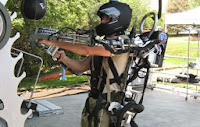
 DARPA and Raytheon have developed a 200 pound aluminum exoskeleton which, when energised, not only holds up it's own weight, but gives the human wearer a ten-fold increase in arm and leg power. In the example given, supply personnel could lift and load 35-pound boxes of ammunition all day without tiring. But it requires a lot of power and is tethered to the source. It's not for portable use in the field.
 The WASP is an electrically-driven remotely-controlled "model" airplane about 26" long capable of carrying daylight or infrared cameras for 45 minutes.
 Powerswim is a device that lets swimmers travel 150% faster than using swim fins and with less effort because it uses more powerful muscles (quadricep and gluteal muscles.) It's shape is derived from observation of whales, dolphins, and seals as they swam.
 But not every project is cheap. DARPA, working with the Lockheed-Martin Skunk Works, is developing the Falcon HTV-3X scram jet, capable of travelling for hours at over 4,000 miles per hour.
The Foliage Penetration Reconnaissance, Surveillance, Tracking and Engagement Radar (FORESTER) can be carried aloft by unmanned helicopters and see through foliage to detect troops and vehicles not otherwise visible.
Perhaps their best-known project is the DARPA Grand Challenge, first issued in 2004 with a $1,000,000 grand prize for the first autonomous vehicle capable of negotiating a long obstacle course in a limited amount of time with no external control other than start and stop. Hundreds of teams have participated from high schools, universities, businesses and other organizations. The only requirement is that at least one member of the team be a US citizen. The prize was increased to $2,000,000 in 2005 and was finally claimed in 2007. The first, second and third places winners in the 2007 Urban Challenge received $2 million (CarnegieMellon, 4 hrs, 10 mins,) $1 million (Stanford), and $500,000 (Virginia Tech), respectively.
And there are hundreds of other projects that you can get an idea about by going to the DARPA web site list of on-going programs.
Current projects look tame by comparison, at least the projects they will talk about. But we are assured that more life-changing inventions are under development. Some of the projects that they will talk about include:

 Boomerang; a device designed to determine the origin of an incoming bullet or rocket-propelled grenade (RPG). It was developed in about two months in 2004 and deployed to Afghanistan. It doesn't wait for the sound to reach it; by that time, it would have been blown to pieces. It detects the shock wave that precedes the object. Shock waves travel faster than the objects which produce them.
 Knowing that you are about to be destroyed in the next few milliseconds is not much consolation, so DARPA developed the "Iron Curtain," a somewhat bulky add-on to a Humvee that both detects and destroys incoming RPGs before that can strike the vehicle.
Iron Curtain and several of the other devices mentioned here were the subject of a National Geographic special titled "America's Secret Weapons Lab." It was broadcast today and will be rebroadcast 11 December.
DARPA is also developing a self-generating network for field communication and situational awareness. For example, three or more Humvees using Boomerang could precisely pinpoint the location of a sniper or grenade launcher and communicate that information to all vehicles and personnel in the area.

 DARPA and Raytheon have developed a 200 pound aluminum exoskeleton which, when energised, not only holds up it's own weight, but gives the human wearer a ten-fold increase in arm and leg power. In the example given, supply personnel could lift and load 35-pound boxes of ammunition all day without tiring. But it requires a lot of power and is tethered to the source. It's not for portable use in the field.
 The WASP is an electrically-driven remotely-controlled "model" airplane about 26" long capable of carrying daylight or infrared cameras for 45 minutes.
 Powerswim is a device that lets swimmers travel 150% faster than using swim fins and with less effort because it uses more powerful muscles (quadricep and gluteal muscles.) It's shape is derived from observation of whales, dolphins, and seals as they swam.
 But not every project is cheap. DARPA, working with the Lockheed-Martin Skunk Works, is developing the Falcon HTV-3X scram jet, capable of travelling for hours at over 4,000 miles per hour.
 The Foliage Penetration Reconnaissance, Surveillance, Tracking and Engagement Radar (FORESTER) can be carried aloft by unmanned helicopters and see through foliage to detect troops and vehicles not otherwise visible.
Perhaps their best-known project is the DARPA Grand Challenge, first issued in 2004 with a $1,000,000 grand prize for the first autonomous vehicle capable of negotiating a long obstacle course in a limited amount of time with no external control other than start and stop. Hundreds of teams have participated from high schools, universities, businesses and other organizations. The only requirement is that at least one member of the team be a US citizen. The prize was increased to $2,000,000 in 2005 and was finally claimed in 2007. The first, second and third places winners in the 2007 Urban Challenge received $2 million (CarnegieMellon, 4 hrs, 10 mins,) $1 million (Stanford), and $500,000 (Virginia Tech), respectively.
And there are hundreds of other projects that you can get an idea about by going to the DARPA web site list of on-going programs.
Subscribe to:
Posts (Atom)
